
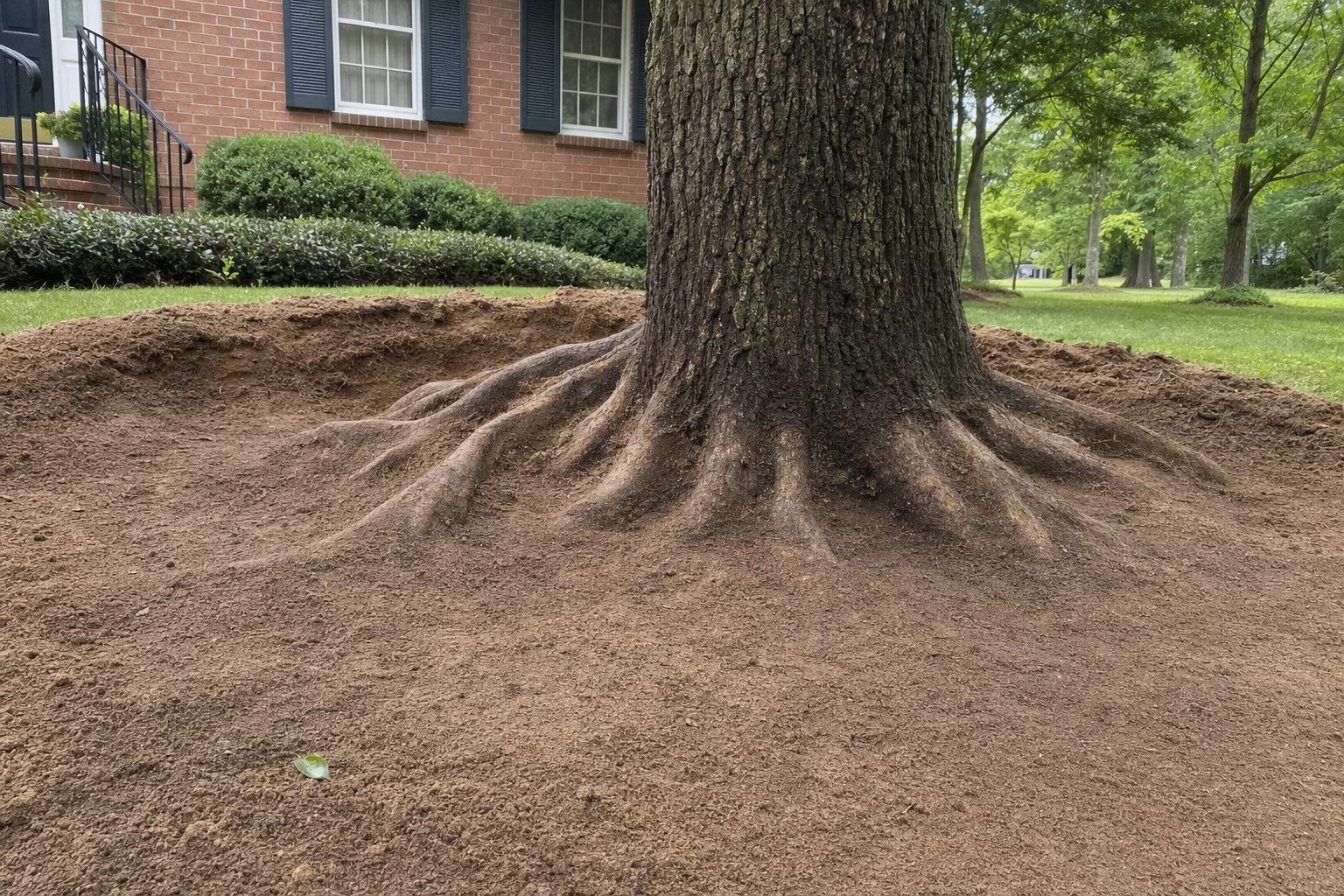
The trouble may be at the base, where you can't see it. Root collar excavation means digging the soil away by hand until the flare, where the trunk widens into the roots, is showing, then cutting any root found wrapped around the trunk. People call Northgate Tree Service when a tree that should be healthy is declining slowly, or when a patio, fill, or years of mulch have buried the collar. Describe the tree when you phone and you'll hear the usual price range while you're still on the line. The firm figure goes in writing once we've seen the base.
How much does root collar excavation cost in Augusta-Richmond County?
Root collar excavation runs $450 to $1,100 per tree in Augusta-Richmond County, and Northgate Tree Service writes the exact figure down before any digging starts.
Your number follows what's under the mulch. The first factor is how much soil has to come off. The second is how many main lateral roots are involved. The third is whether girdling roots turn up that need cutting with hand pruners. A few inches of soil over the flare and nothing circling keeps the job near the $500 end. A tree with the whole root crown buried under years of mulch, or with several circling roots to follow back to where they start, sits higher. Because the digging is done by hand, the labor is what you're paying for.
Often paired with a tree health inspection. Need tree service augusta in Augusta-Richmond County? Start on our home page.
Helpful next: Tree Service Augusta Step by Step: What the Job Involves · Hiring a Tree Service Augusta Contractor: Questions Worth Asking First
Why do root collars end up buried or strangled?
Two things do it: material piled over the root flare, and roots that circle the trunk instead of spreading outward. Mulch, added fill, or a change in grade buries the flare. Girdling roots tighten as they thicken and squeeze the trunk like a wire cinched around a hose.
Burial is usually something that was put there. Soils here are very deep and drain only somewhat poorly, so water can linger around a buried collar. They also have low shrink-swell potential, so the ground rarely heaves enough to bury a trunk on its own. What's on your lot depends on its mapped soil. Now and then a winter freeze moves the soil a little around the trunk.
How can I tell if my tree needs this?
Look at the base first. A trunk that goes straight into the ground with no widening flare, or bark that looks sunken just below soil level, points to a buried collar. A thin or yellowing canopy on one side while the rest looks fine can point to a girdling root on that side.
Small leaves, slow annual growth, and early fall color are stress signs that show up well before a tree dies. Think back over recent work too. If a patio went in, fill was brought in, or the beds were re-mulched, the collar may be buried now even though it was clear before. A thin crown has other causes, though. If the flare is already visible and nothing circles the trunk, you don't need this work. We'd say so before putting a shovel in the ground.
What does the digging actually involve?
We dig by hand. Hand digging tools expose the upper root system, meaning the highest main lateral roots at the soil surface, and hand pruners remove girdling roots only when they're there. Nothing gets cut on a hunch.
We work outward from the trunk so no machine runs over roots that are already under stress. Once the flare is showing, we look for roots that circle the trunk or grow back toward it. A girdling root gets one clean cut with the pruners, and every other root stays as it is. If nothing is girdling, the pruners stay in the truck and the job is just uncovering the flare. Going slowly matters here because a root cut blind is damage you can't undo.
Does the work need a permit?
Digging at a root collar isn't tree removal. So if your tree is protected or a landmark and it turns out it can't be saved, the permit comes first.
If the tree is on public ground or might be protected, mention it when you phone. It's easier to sort that out before anyone picks up a saw.
What should I do after the flare is uncovered?
Keep mulch and soil off the flare from here on. The collar was uncovered so the base can shed water and the trunk can sit at grade again, and new material piled against it starts the problem over.
With the flare exposed, you can see any change yourself. Glance at it after a cold snap, since freeze-thaw movement can shift loose soil and mulch back toward the trunk. If you re-mulch, pull it back from the trunk and don't pile it on the flare.
What's the first step to find out what's at the base of my tree?
Call Northgate Tree Service and describe the tree. You'll hear the usual range for this work before any booking, and nothing has to be decided on the call. The written price follows a look at the base: how deep the collar is buried, and whether any root is girdling.
Related Services
Questions Welcome
You can explain it on a quick call, and the decision stays yours.